Poetry (Months 4 & 5)
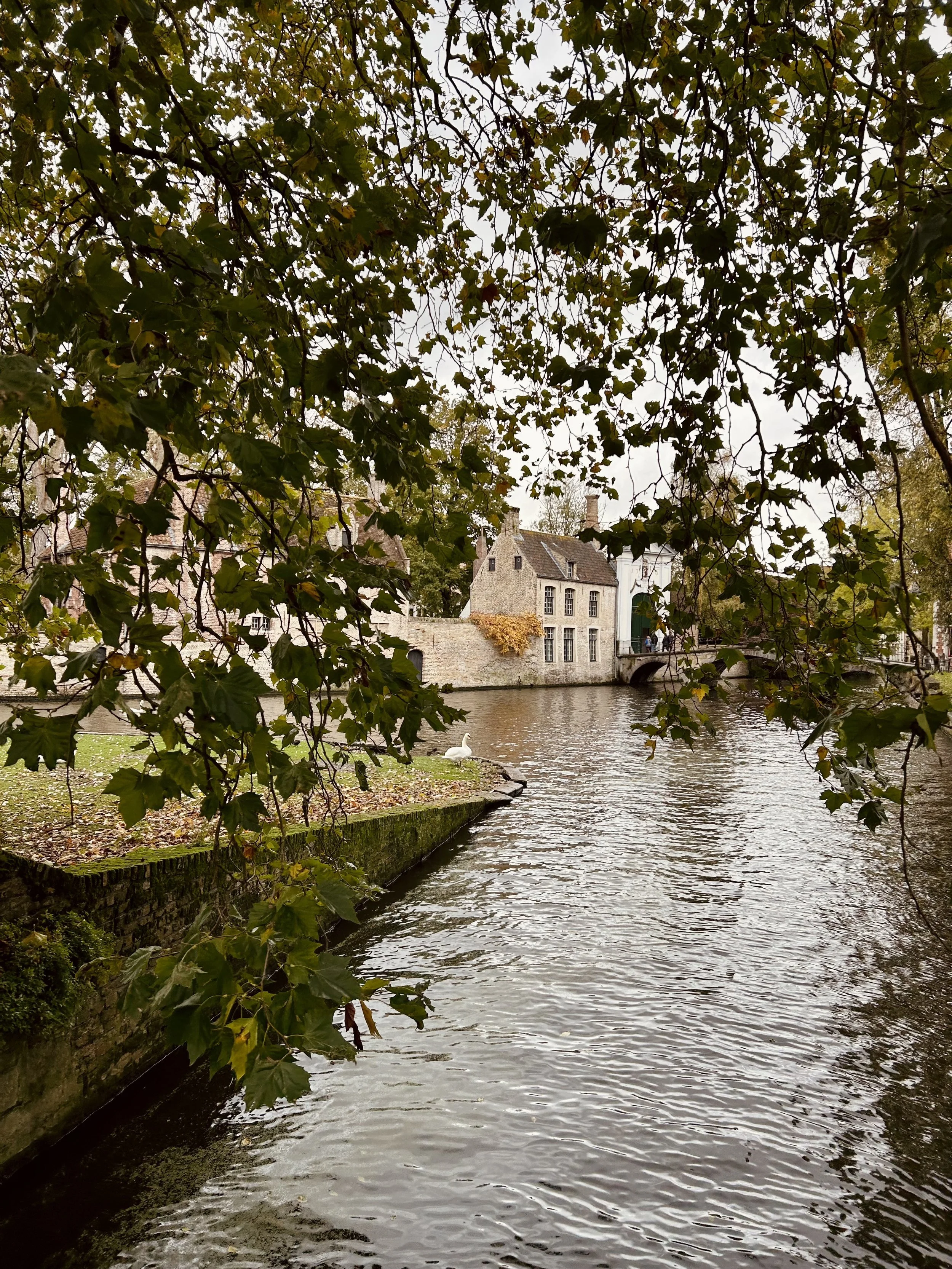
I love reading poetry collections and sensing the overwhelming obsession the poet has with certain images. In Louise Glück’s The Wild Iris, it is the ladder, birch trees, a person wandering through a garden. I think, she’s just like me—my thought processes obsessed with one symbol that will carry me through. Am I wrong by suggesting poets depend on it? This is our dilemma, if you’ll allow me. I am attached to an image, an essence, that must remain consistent. When it fails—which they almost always inevitably do—I must search for a new one.
There is an agency and urgency in Glück’s poems that I admire and in which I identify my own last attempts at poetry. “I will constitute the field,” she writes in “Witchgrass.” “This is how you live when you have a cold heart. / As I do…” (“Lamium”). “I am no needier / than other people.” (“Matins,” p. 13) There is assurance even when the speaker acknowledges her faults, which somehow pushes even deeper into confessionalism and emerges as an attempt at describing nature. It is fact. I love this confidence. It is everything I cannot seem to do nearly as well on my own but can do with poetry. It’s as if it must say, here is my truth and my writing it down is a feat that I must celebrate.
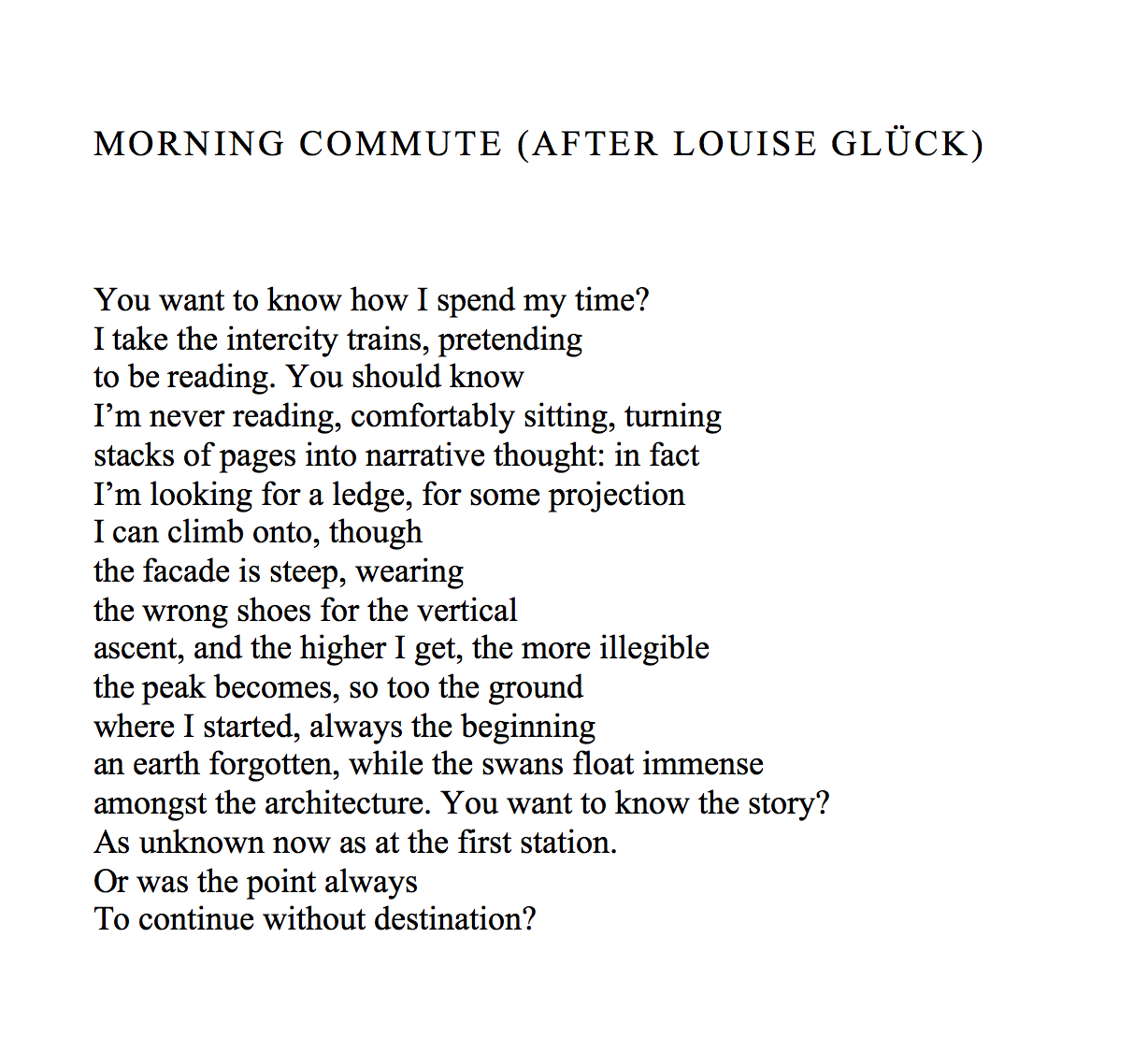
My recent predicament is that the study of literature is so much less about the specifics of literature and more so about the generalities of Literature (with a capital L). I am reading so much theory. I am heavily investigating -isms. In technical abilities, I feel behind my other classmates - who have studied literary theory as undergraduates - and creatively, I feel sort of useless. I tried to bring up character arc in my last class. My professor changed the subject, or rather diluted conversation on it by saying we must take limited character arc as still a way to imagine possibilities. But I think I disagree. Will they let me disagree? My idea of literature is that it is at every moment evolving. Why not ask for (no, demand) something better? Why not allow the faults be faults and the progress be progress, instead of needing to look at the faults as explanations for potential? Why not the tangents? I miss them. I hate the rigidity. I know I have put myself here. I always knew the different type of scopes and lenses I would have to grow accustomed to in an English Literature Masters (versus a Creative Writing MFA) would be ones of technicality and “scholarship.” But how (much) do I allow the University to influence or inspire my next move? How do I survive this (very privileged) process, without letting my internal dialogue be about scholarly adeptness instead of inquisitive openness? I think of my dear classmate in our undergraduate program, who only read the books and did the assignments he thought useful to himself and his writing. This is a type of genius and creative self-care (and also perhaps a decided limiting). If only I cared less about others' evaluations of me. Perhaps this is all to get me there. Here is a poem, after one of Louise Glück’s “Matins” that I wrote instead of reading a book for class.
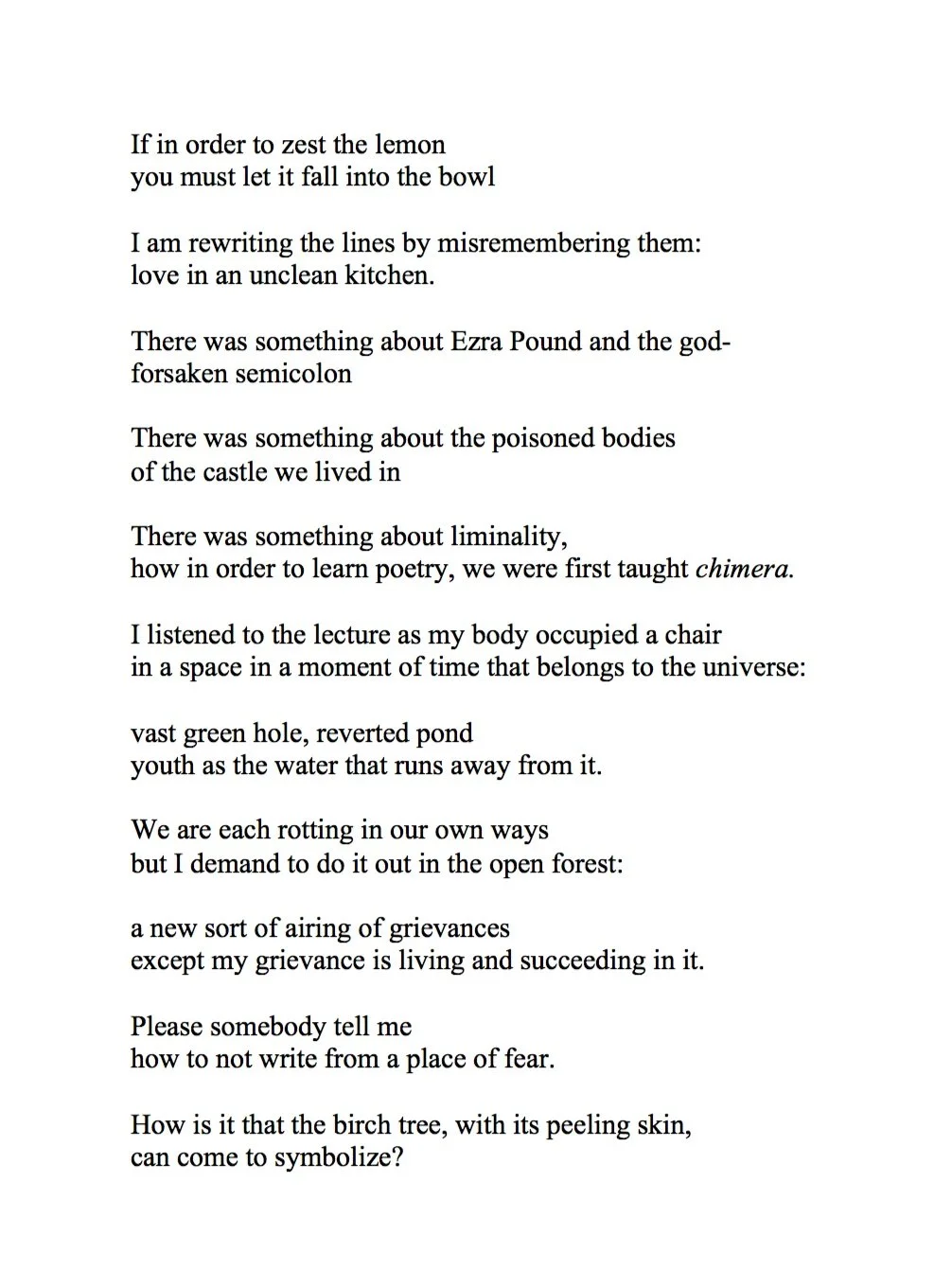
And here are some strung-together couplets with images I’m experimenting with being obsessed with.
I guess this is all to say that poetry is still my salvation. Admittedly, Jane Austen and the theories of Deleuze and Guattari and Franco Moretti have overrun the forefront of my mind. It is fun and feels cool to reference them, but it’s poetry I miss - birdsong, images, symbols that aren’t just analogies but lifelines, buoys, tugboats, anchors that chip off at the bottom of the ocean because of rust and age. It’s the act of generating that completes my routine. But that’s also just my habit. I think it’s okay to need to take a breather - to let old, familiar things permeate from the depths - and to re-evaluate the role one or another thing works in the mechanisms of daily life.